Pinching Your Nose at the End of Blowing Your Nose Blocks It Again
If you take a blocked or runny nose, chances are you'll accomplish for a tissue or hanky to articulate the mucus by having a proficient blow.
Simply is at that place a right way to blow your olfactory organ? Could some ways brand your cold worse? And could you actually practice some damage?
The three most mutual reasons for extra mucus or snot are the mutual common cold, sinusitis (infection or inflammation of the sinuses, the air-filled spaces inside the face up bones) and hay fever. Each of these atmospheric condition cause the lining in the nose to not bad up, and to produce extra mucus to flush away infection, irritants or allergens.
Both the swelling and extra fungus atomic number 82 to nasal congestion. This is when the narrowed passages increment the effort of animate through the nose. Clearing the fungus by bravado the nose should reduce this congestion somewhat.
At the beginning of colds and for nearly of the fourth dimension with hay fever, at that place's lots of runny mucus. Blowing the nose regularly prevents mucus building up and running down from the nostrils towards the upper lip, the all-too-familiar runny nose.
Later in colds and with sinusitis, nasal mucus can get thick, sticky and harder to articulate.
Further reading: Wellness Check: what you need to know about fungus and phlegm
Think of "snotty nosed kids", in item infants or toddlers who haven't however learnt to coordinate the mechanics of blowing their noses. They tend to repeatedly sniff thick mucus dorsum into their nose or allow information technology to dribble downward their upper lip.
Keeping this fungus (rather than blowing information technology out) is thought to contribute to a cycle of irritation that causes the snotty nose to persist for weeks or longer.
This may be due to the retained mucus acting as a adept "abode" for bacteria to abound in, also as fatigue of the "hairs" (cilia) that cleanse the nose by moving along mucus and carrying with it irritants, inhaled debris and leaner.
Thick retained fungus is likewise more likely to be transported to the pharynx rather than gravity working it from the nostrils, leading to throat irritation and perhaps a cough. This is the machinery behind the most common cause of prolonged cough after a viral infection or hay fever, known as the post-nasal drip cough.
So it makes sense to encourage people to blow their nose to remove unwanted mucus.
Rare risks if y'all accident too hard and likewise often
Although extremely rare, there are a few examples in the medical literature of people blowing so difficult they generated pressures high enough to cause serious impairment. In most of these cases people had underlying chronic sinusitis or an existing weakness in the structure they damaged later blowing too hard.
These injuries included fractures of the base of the eye socket; air forced into the tissue between the two lobes of the lung; severe headache from air forced inside the skull; and rupture of the oesophagus, the tube that sends food to the stomach.
1 study looked at the pressures generated when people with and without a range of nasal complaints blew their noses.
People with chronic sinusitis generated pressures significantly higher than people without a nasal complaint, up to 9,130 Pascals of pressure. They also found bravado by blocking both nostrils generated much higher pressures than blowing with ane nostril open.
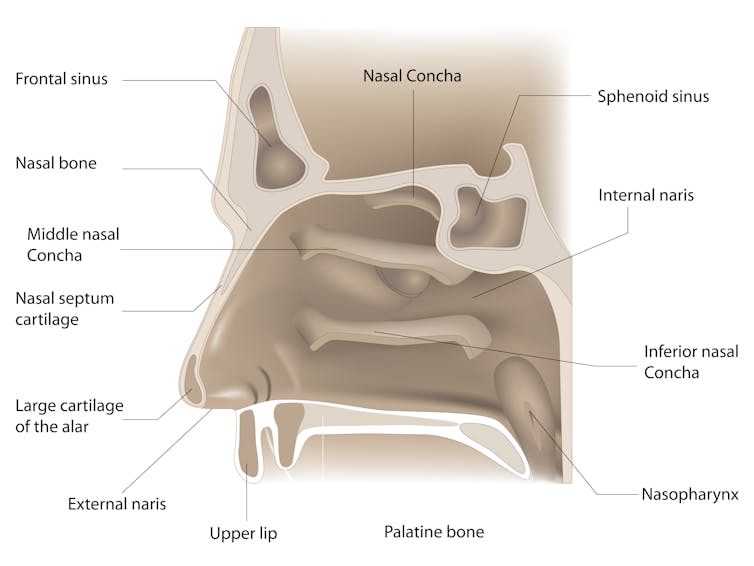
Some other written report comparing pressures from nose blowing, sneezing and coughing found pressures generated during bravado were about ten times college than during the other two activities.
More worrying was their 2nd finding – viscous fluid from the nose had establish its way into the sinus cavities after vigorous nose blowing. The researchers said this could be a mechanism for sinus infection complicating some colds, with the introduction of nasal bacteria to the sinuses. But they did not produce show for this.
On balance information technology seems repeated and vigorous blowing of the olfactory organ may behave more than hazard than benefit, fifty-fifty though it seems to be a natural response to nasal congestion.
Can I take anything to stop the snot?
So looking to remove the need to blow so forcefully is probably a better option.
Decongestants and antihistamines, which you can buy without prescription from pharmacies, reduce both nasal congestion and the volume of mucus.
Decongestants contain ingredients like oxymetazoline and phenylephrine and come in tablets or sprays, and are ofttimes included in cold and flu tablets. They piece of work past constricting (narrowing) dilated claret vessels in the inflamed lining of the olfactory organ, and decreasing the volume of mucus produced.
While decongestant sprays are effective, they are probably underused due to concerns nigh nasal congestion when y'all terminate taking them after long-term apply (rhinitis medicamentosa). But farther studies accept questioned this increased risk.
Antihistamines care for nasal congestion associated with hay fever, but may exist less effective for treating common cold symptoms.

Saline nose sprays have some evidence they work for acute and chronic rhinosinusitis (inflammation of the nasal lining and sinuses), and tin reduce the need for medications. They are believed to clear mucus through increasing the effectiveness of the cilia too as diluting thick and sticky mucus.
A related technique, known as nasal aspiration, is when you squirt liquid saline up the nose with a special medical device to flush out mucus and debris from the nose and sinuses. One study institute information technology lowered the risk of developing acute otitis media (inflammation of the middle ear) and rhinosinusitis.
What's the verdict?
If you have mucus in the nose, it is probably best to get it out, so accident gently or by immigration 1 nostril at a time. Use of advisable treatments can lessen the demand to blow, and the force required to articulate your nose.
If you are repeatedly bravado your nose you lot probably have a nasal condition, like hay fever or sinusitis, which should be treated more comprehensively.
And if yous see a snotty-nosed kid, please wipe away the mucus discharge for the benefit of all.
Source: https://theconversation.com/health-check-whats-the-right-way-to-blow-your-nose-74977
0 Response to "Pinching Your Nose at the End of Blowing Your Nose Blocks It Again"
Post a Comment