What Is the Problem With Using Your Boats Engine to Drive It Onto a Trailer?
"Wait over there, under the gunwale," says the skipper to a guest who needs a gunkhole hook to help snare a mooring line. "Under the what?" the guest asks. "Over in that location on the starboard side, under the gunwale," the skipper says, calculation, "It'due south just ahead of that cockpit stowage locker." Obviously aggravated, the guest says, "Tin can yous speak English, please? And what the heck does 'mooring' mean?"
Boating terminology can be a frustrating barrier to communication on a boat, especially between quondam salts and newbies. While information technology may appear as if the folks who use this sometimes confusing linguistic communication are just speaking perplexing words to be snobby, that's generally not the case. Trust u.s.a., knowing the vernacular is an of import part of being a capable boater—information technology's not some undercover language boaters use to sound cool.
With that in mind, nosotros've assembled a basic yet comprehensive glossary to assistance you beginning downwardly the road to gunkhole-speak fluency. While a full business relationship of these words could stretch on for an endless number of pages, nosotros've listed the true essentials you lot'll need to become a competent member of any boat crew and even sound like it.
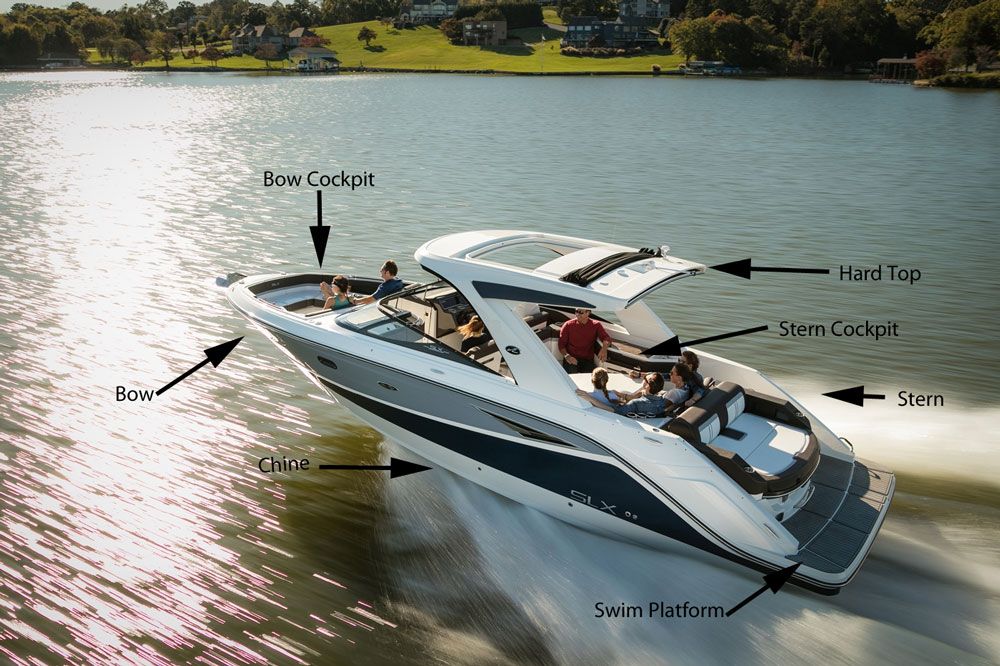
Do yous know the bow from the stern? If non, you volition subsequently reading this commodity.
Parts of a Boat
Perhaps the about important terms y'all can know as a boater are the words that identify the many different parts and pieces that make up a gunkhole. Whether you're asking someone to shut the door to the head or secure a slice of gear in the aft locker, having a basic cognition of the post-obit boat terms volition go a long mode to advancing your nautical lingo.
Ballast: Weight added to a boat to enhance stability. "The J/24 has 950 pounds of pb ballast."
Berth: A sleeping surface area on a boat. Also, a place where a boat is tied up. "Nosotros slept in the forward booth while John and Amy slept in the quarter berth" or "We continue our boat in a berth at McDoodle's Marina."
Bilge: The everyman section of a boat where water typically collects. "The shower sump is located in the bilge."
Bimini: A blazon of folding sail top used to shield occupants from pelting and sun. "It was nice and absurd in the aft cockpit under the Bimini top." Y'all can watch one being set up and see how it works when deployed, in our Cruisers Sport Series 258 video boat review.
Bow: The forward end of whatsoever boat. "John went up to the bow to lower the anchor."
Bulkhead: Typically a transverse structural component in a boat that frequently supports a deck. "The aft bulkhead separates the main saloon from the engine room."
Cabin: An enclosed and protected area on a boat. "The boat'south motel was broad and roomy with plenty of space for relaxing out of the weather." Information technology tin range from a pocket-size "cuddy cabin" to large living spaces with multiple rooms, which themselves may be referred to as cabins.
Cabintop: The apartment or curved deck surface above an enclosed structure on a boat. "At that place is enough of infinite upon the motel top to stow the dinghy."
Casting Platform: A raised, open deck on a fishing boat used for casting a fishing rod. You tin see a great instance of casting platforms on the Pathfinder 2600 HPS.
Chine: The office of a boat where its hull sides and bottom intersect. "The boat's chines were precipitous and angled, which gave it an aggressive await."
Cleat: A metallic or plastic fitting used to deeply adhere a line. "Peter tied off the fender to the starboard amidships cleat."
Coaming: Raised edges, or sides, designed to assistance keep waves and water from entering a certain area of a boat. "The cockpit has an ample coaming to proceed the area dry and give it a secure feeling."
Cockpit: Any semi-enclosed, recessed area that is lower than the surrounding decks, such equally the cockpit of a sailboat or a eye-console powerboat. "The libation was stowed in the aft cockpit."
Companionway: An entryway that provides access to the below-decks spaces on a boat. "The galley is located merely below the companionway, to port."
Console: A raised area higher up the deck or cockpit that occupants ofttimes sit down or stand backside while the boat is underway. "John drove the gunkhole from the helm, which is located in the starboard console."
Deck: Essentially any exposed, apartment exterior surface on a boat that people stand on. "The decks were awash with salt water after the wave crashed over them."
Dinette: An area for dining on a gunkhole, typically with a table ready between 2 seating areas. "The main saloon has a huge dinette to starboard." There'southward a peachy photo of 1 in our Prestige 620 S Flybridge review.
Flybridge: A steering station, sometimes with a small-scale entertaining infinite, congenital atop a boat's cabin. It's also sometimes chosen a 'flying bridge'. "We ran the gunkhole from up in the flybridge, which gave us a great view out over the body of water."
Foredeck: The forward-about deck on a gunkhole. "The anchor windlass is located upon the bow; yous can access it from the foredeck."
Galley: An expanse on a gunkhole where food is prepared. "John steamed upwardly the lobsters on the stove in the galley."
Gunwale: The top edge of a boat'southward hull sides. "The line-fishing rod racks are located forth the starboard gunwale."
Hardtop: A supported fiberglass or composite roof-like external construction that covers a portion of a boat. "We mounted the radar dome on the hardtop" or "The hardtop covers the middle console unit."
Hatch: The cover or door that closes over any opening in a boat's deck or motel acme. "The frontwards hatch allowed lots of natural light inside the boat."
Head: The bathroom on a boat. "An enclosed head is fitted underneath the center console, for when nature calls."
Captain: The area of a boat where the steering and engine controls are located. "Betsy steered the gunkhole from the helm."
Hull: The physical portions of a gunkhole that sit in the water. "The Jones Brothers Cape Fisherman 23 has a hull shape that cuts through waves with ease." See our Gunkhole Hull Basics video, to learn about different hull shapes.
Inboard Engine: An engine that is mounted inside the hull of a boat. "The boat has a 237-horsepower gasoline inboard engine." Boats may be called inboards whether they have a straight shaft running through the hull (such as the Marlow Pilot 34), a stern-bulldoze going through the transom (like the Monterey 218SS), or pod drives going through the bottom of the gunkhole (every bit in the case of the Body of water Ray L590).
Jib: Generally the smaller of two or more than sails on a sailboat, flown forward of the mast. "Gael trimmed the jib in tight equally she sailed a form against the wind."
Spring Seats: Small, pop-up seats usually located in the aft cockpit of a powerboat. "The Everglades 243cc has twin pop-upwards jump seats in the aft cockpit."
Lifelines: Cables or lines used to foreclose people or gear from falling overboard. "Andrea grasped the lifelines firmly as she walked forward on the starboard deck."
Livewell: A specialized compartment on a boat designed to keep fish, shrimp, and other angling bait live. "Fred stocked the livewell with a bunch of minnows."
Locker: An area on a gunkhole where gear is stowed. "The tackle boxes are in the aft stowage locker."
Mainsail: Generally the largest sail on a sailboat. "Eve hoisted the mainsail equally John pointed the boat into the wind." (See Basic Sailing and Seamanship: Making Sense of Sails to larn more than well-nigh the different sails constitute on sailboats).
Mast: A vertical structure, commonly made of aluminum, which supports sails on a sailboat. "We hoisted the mainsail up the mast earlier raising the jib."
Keel: The lowest portion of a boat'south hull as it sits in the water. Also, a hull bagginess that improves stability. "The Bristol 24 has a full keel that helps improve its lateral stability."
Outboard Well: A recessed expanse on a boat just forrard of where an outboard engine is mounted. "The outboard well filled with h2o when we backed the boat down into a gear up of waves."
Outboard Engine: An engine that is generally mounted to the transom of a boat that has a self-contained engine block, manual, and lower drive unit. "The boat has a 350-horsepower outboard engine on its stern." You can acquire more about different engines and drive systems by reading Marine Engines and Power Systems.
Pod Drives: Inboard engines mounted above articulating drive units that protrude through the bottom of the boat. "Pod drives provide excellent treatment and maneuverability." Read All Most Pod Drives to learn more.
Propeller: A rotating device that is paired with an engine to propel a boat through the water. "The outboard has a stainless-steel propeller." Watch our How do Propellers Piece of work video to larn more about propellers (besides called 'props').
Rigging: The lines and wires that support and help control a spar or mast. "The backstay, forestay, and side stays are some of the rigging that supports the mast."
Rubrail: A protective outer chemical element on the hull sides that helps protect the hull from damage. "The rubrail rested against the piling, protecting the boat's hull."
Rudder: A vertical hull appendage that controls steering. "The Farr 40's long, slender rudder makes the boat highly maneuverable."
Saloon: A room in the cabin on a boat that's usually the master entertaining expanse. "We served cocktails in the principal saloon; it was a cracking area for entertaining our guests."
Scuppers: Deck drains that channel h2o from rain and spray overboard. "The cockpit filled with water, but was quickly tuckered by the scuppers."
Sheer Line: The outline of a boat'due south deck at the gunwale or hull-deck joint from bow to stern. "The boat has a sheer line that rises gracefully toward the bow."
Stateroom: An enclosed motel in a boat with sleeping quarters. "The master stateroom had luxurious accommodations, including a queen-size berth."
Stern: The aft-most section of a boat's hull. "We mounted the swim ladder on the boat'south stern."
Stern Bulldoze: A propulsion system consisting of an inboard engine with a steerable drive organization that is mounted to the transom. "The boat was fitted with twin MerCruiser inboard gas engines coupled to stern drives." You lot tin learn more about different engines and bulldoze systems by reading Marine Engines and Power Systems.
Swim Platform: A structure on the stern of a boat designed to make getting in and out of the water easier. "Janie sat on the swim platform with her legs dangling in the water."
T-Top: A metallic structure on a boat that is usually topped with a section of sail or a hard top to protect occupants from lord's day, spray, and pelting. "George and his crew huddled under the T-top during the rainstorm."
Tiller: A forest, metal, or composite handle that is connected to the rudder(s) or a small outboard and used to steer a boat. "Every bit the current of air increased, Blair pulled difficult on the tiller to proceed the boat on course."
Toerail: A wood or fiberglass track or dabble located effectually the outside edge of a gunkhole'southward deck, commonly situated near where the hull sides run across the deck. "The boat'southward teak toerail was beautifully varnished."
Topsides: The portion of a boat'south hull that is to a higher place the waterline. "Jenny polished the topsides to a cute shine."
Transom: The aft-nearly section of a boat that connects the port and starboard sections of the hull. "Nearly people put a boat's name on the transom, though some put it on the hull sides."
Trim Tabs: Adjustable metal plates on a powerboat'due south hull lesser or transom that help adjust the boat'southward running attitude, pitch, and scroll every bit it moves through the water. On a sailboat, a unmarried trim tab may be located on the aft edge of the keel to help the boat steer meliorate in sure atmospheric condition. "Jim adjusted the trim tabs to make the powerboat'due south bow ride further down in the water."
5-Booth: A booth that is situated in the bow of a boat. "Fred took a nap in the V-berth."
Waterline: The line around a gunkhole's hull where it intersects the water. "We spent all day scrubbing the boat's waterline."
Boat Measurements
The best mode to become an idea of what a gunkhole is designed for and how information technology will act in the water is to accept a await at some of its key measurements and specifications. Know these terms and you lot're on your fashion to beingness able to place the key characteristics of whatsoever given boat you come beyond in person, or in a review or video.
Beam: The measurement of a boat'southward width at its widest point. "The Boston Whaler 320 Outrage has a x-foot, ii-inch axle."
Deadrise: The angle of a powerboat hull's "Five" shape, normally measured in degrees at the transom. "The gunkhole has a whopping 24-caste transom deadrise, which makes information technology extremely capable in rough water."
Deportation: The weight of water displaced by a boat's hull. "The boat displaces xviii,200 pounds." A boat's displacement is equal to its weight at any given fourth dimension, with any given load.
Typhoon: The total distance a boat penetrates the water, from waterline to keel or appendage bottom. "The Schenectady 54 has a draft of 4 feet, six inches."
Dry Weight: The weight of a gunkhole without fuel or h2o onboard. "The boat has a dry weight of 3,456 pounds."
Freeboard: The distance between a boat's waterline and the summit of its gunwales. "The boat's loftier freeboard fabricated united states of america feel secure in the big waves."
Length Overall: The overall length of a boat, as measured from its aft-most to forrad-near appendages. Sometimes abbreviated "LOA." "The boat had a length overall of 21 feet, v inches, from its swim platform to the bow sprit."
Waterline Length: The length of the hull where it intersects the h2o, from bow to stern. Sometimes shortened to "LWL." "The superyacht has a waterline length of 102 feet."

Is that a center console, or is it an express cruiser? Read on, to find out.
Types of Boats
While it'south not an essential boating skill to be versed in every type of power and sailing arts and crafts out on the water, most accomplished boaters know how to identify a scattering of unlike basic boat designs, as well as what they're designed to do. Hither's a listing of the most popular types.
Bass Boat: A type of boat that generally has a flat deck, depression freeboard, and a shallow typhoon that is used primarily for fishing protected lakes and rivers. The Triton 21 TRX is a prime number example of a bass boat.
Bay Gunkhole: A low freeboard center console fishing gunkhole designed for nigh-shore and littoral utilize. To learn more, check out our comprehensive explore section on Bay Boats.
Bow Rider: A powerboat with a seating surface area set in its bow. Consider checking out our buyer's guide Bowriders.
Cabin Cruiser: By and large, any larger powerboat that provides sleeping accommodations inside its structure. This generic term can exist used to describe motor yachts, expresses, and a number of unlike designs.
Catamaran: A power or sheet arts and crafts with two hulls.
Center Console: A powerboat with its panel and helm located in a fundamental location on deck. Read our explore section on Center Consoles to go the skinny on this class of boats.
Cuddy Motel: A powerboat with a relatively small motel on its bow section. Learn what makes these great boats tick by checking out our feature Cuddy Motel Boats: Family-Friendly Fun.
Deck Gunkhole: A powerboat with a flat, open deck programme and without any below-decks accommodations. Most deck boats have a rather boxy shape, instead of tapering to a point at the bow, to create more than forrard deck infinite. The Hurricane Sundeck is a classic instance.
Downeast Boat: A traditional mode of boat that is derived primarily from commercial Downeast lobster boat designs of the American Northeast.
Dual Panel: A boat with twin dashboards that are separated by a walk-through that allows admission to a forwards cockpit or seating expanse. You lot can get an thought of what these boats are all almost past reading our Dual Console Boats explore section.
Express Boat: A sleek powerboat with a steering station on deck level, no flight bridge, and a cabin forward of and lower than the helm station. Folks in the market place for an express cruiser would exist wise to browse our Express Cruiser explore department for more data.
Flats Boat: A powered skiff designed with an extremely shallow draft for fishing on flats and other shallow h2o areas.
Firm Boat: But as the name implies; these are boats that have large home-similar accommodations built on a barge-like hull.
Inflatable Boat: Any gunkhole with inflatable sponsons and a flexible bottom. Learn more well-nigh these utilitarian arts and crafts by reading our article on Choosing the Perfect Inflatable Gunkhole.
Jon Boat: Pocket-size utilitarian arts and crafts with a flat lesser, which are usually constructed of aluminum. Nosotros reviewed an entire series of jon boats in our Frontier Series Video Boat Review.
Multi-species Boat: An open and rugged dual console boat with a utilitarian cockpit that's designed primarily for fishing lakes and rivers. Nigh are constructed of aluminum.
Personal Watercraft: Small, open, jet-power watercraft that can seat ane to three people. Oftentimes abbreviated as "PWC."
Pontoon Boat: A apartment-decked boat with a perimeter fence built atop two or more pontoons. Observe out all most these political party platforms by reading Pontoon Boats.
Rigid Inflatable Boat: An inflatable boat with sponsons built effectually a rigid fiberglass or aluminum hull. Also known equally "RIBs."
Runabout: A generic term used for any small powerboat, generally meant for twenty-four hours-boating with limited (if any) beneath-decks accommodations.
Sailboat: Any boat driven by sails.
Sloop: A sailboat with ane mast, a jib and a mainsail. The nigh common type of sailboat.
Sportfish Yacht: More often than not a large offshore line-fishing boat with an expansive aft cockpit, narrow side decks, a generous foredeck, and a flybridge that sits above a capacious main saloon.
Tow Boat: A gunkhole designed and built with an eye toward towing people who savour watersports such as wakeboarding, wake surfing, or water skiing. Oft, these are also chosen watersports boats.
Trawler: A rugged, long-distance recreational powerboat designed for cruising that resembles commercial fishing trawlers.
Trimaran: Whatever boat with three hulls.
Walkaround: A fishing boat built with side decks that allow anglers to walk around the motel house and upwardly to a foredeck.
Nautical Directions and Terms
If someone asked you, "Can you await in the aft stowage locker for a first aid kit" would y'all know where to look? If not, the following bones nautical terms that employ to direction, location, and speed may be of help to you.
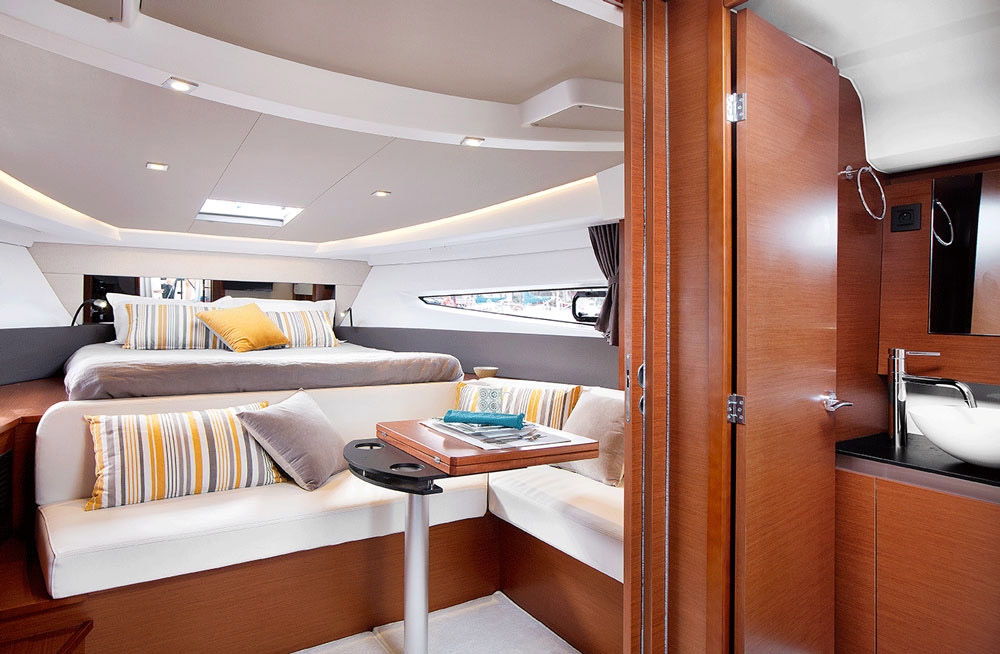
Is that a forward stateroom, or is it aft? Permit's find out.
Aloft: Above the deck, generally in the rigging. "Harry went aloft to set up the VHF antenna."
Abeam: Alongside or at right angles to the centerline of a gunkhole. "The marine police brought their patrol boat just abeam of us."
Aft: Toward the stern of the boat, or closer to the stern than some other item existence referenced. "The captain'south chair is simply aft of the helm station."
Amidships: The fundamental portion of the gunkhole. "Let's keep all the coiffure amidships to balance the boat improve."
Frontwards: Toward the bow of the boat, or closer to the bow than another item being referenced. "The bow seats are simply forwards of the helm station."
Knots: Term used to draw the speed at which a vessel is traveling in nautical miles per hour. One nautical mile is equal to 1.15 statute miles. "We were cruising at 20 knots, which is 23 MPH."
Port: The left side of a boat when facing forrad. "The gear locker is on the port side of the aft cockpit."
Starboard: The correct side of a boat when facing forward. "The boat hook is nether the gunwale on the starboard side.
Docking and Mooring Terms
Docking a boat is an important skill all boaters must learn. If you're new to boating and don't know a bound line from a stern line, you should read Boating Tips: Tips for Easier Docking, Five Docking Disasters: Don't Allow This Happen to You!, and Tying Up Boats: Mooring Basics. In the meantime, y'all can scan the basic docking terms we've divers below.
Bow Line: Dock lines secured to the bow of a gunkhole that limits its movement.
Cleat: A metallic or plastic fitting used to securely attach a line.
Dock: A apartment walkway usually secured to pilings that boats tie upward to. Docks can either be stock-still or floating.
Dock Line: A line made of braided or iii-strand nylon designed to secure a boat along a bulkhead, to a dock, in a slip, or to another gunkhole.
Fender: An inflatable cushion used to protect a gunkhole from contact against pilings, docks, piers, bulkheads, or other boats.
Finger Pier: A flat slender walkway that branches out from a dock and divides 2 slips.
Mooring: This discussion refers to multiple forms of tying up a boat. You tin can call a permanently anchored float with an zipper signal a mooring; yous can phone call a docking line a mooring line, and when your boat is tied up in its slip yous tin can say it's moored.
Piling: A long cylindrical piece of forest or metal driven into the bottom that is used to secure docks in identify or to which boats tin be tied.
Spring Line: Dock lines used to forestall a boat from moving forwards and aft.
Stern Line: Dock line secured to the stern of a gunkhole that limits its motility.
Editor's Notation: This article was originally published in August 2016, updated in August 2018, March 2020 and last updated in March 2021.

Source: https://www.boats.com/on-the-water/beginners-guide-to-boat-terminology/
0 Response to "What Is the Problem With Using Your Boats Engine to Drive It Onto a Trailer?"
Post a Comment