What Types of Intellectual Disability Are Described by the Term Cultural-familial?
Intellectual inability is significantly below average intellectual operation present from birth or early infancy, causing limitations in the ability to acquit normal activities of daily living.
-
Intellectual inability can be genetic or the result of a disorder that interferes with brain development.
-
Most children with intellectual disability do not develop noticeable symptoms until they are in preschool.
-
The diagnosis is based on the results of formal testing.
-
Proper prenatal intendance lowers the risk of having a kid with intellectual inability.
-
Support from many specialists, therapy, and special education aid children achieve the highest level of functioning possible.
The previously used term mental retardation has acquired an undesirable social stigma, so health care practitioners have replaced information technology with the term intellectual inability.
-
Conceptual area: Competence in memory, reading, writing, and math
-
Social area: Interpersonal skills, functional advice, social judgment, and awareness of others' thoughts and feelings
-
Applied surface area: Personal care, task arrangement (for work or school), coin management, and health and safety
People with intellectual disability take varying degrees of impairment, classified from mild to profound. Although fundamentally damage is caused past the decreased intellectual functioning (typically measured by standardized intelligence tests), the impact on the person'southward life depends more on the corporeality of back up the person requires. For instance, a person who has only balmy impairment on an intelligence test may accept such poor adaptive skills that extensive support is required.
Back up is categorized as
-
Intermittent: Occasional support needed
-
Limited: Support such every bit a solar day program in a sheltered workshop
-
Extensive: Daily, ongoing back up
-
Pervasive: Loftier level of support for all activities of daily living, perchance including extensive nursing care
Based only on IQ test scores, about 3% of the population has intellectual inability (an IQ of less than 70). If nomenclature is based on the need for support, only about one% of the population has astringent intellectual disability.

A broad diverseness of medical and environmental weather condition can cause intellectual disability. Some weather condition are genetic. Some are present before or at the time of formulation, and others occur during pregnancy, during birth, or after nascence. The common factor is that something interferes with the growth and development of the brain. Even with recent advances in genetics, especially techniques of chromosome analysis, a specific cause of ID often cannot be identified.
Some causes that tin occur earlier or at formulation include
Some causes that can occur during pregnancy include
-
Infections with human immunodeficiency virus Man Immunodeficiency Virus (HIV) Infection in Children Man immunodeficiency virus (HIV) infection is a viral infection that progressively destroys certain white claret cells and causes caused immunodeficiency syndrome (AIDS). Homo immunodeficiency... read more , cytomegalovirus Cytomegalovirus (CMV) Infection in Newborns Cytomegalovirus is a common virus that usually causes few or no problems but can cause serious illness in infants who are infected before birth or around the time of nascence. Cytomegalovirus infection... read more , herpes simplex virus Canker Simplex Virus (HSV) Infection in Newborns Herpes simplex virus infection unremarkably causes only abrasive, recurring blisters in healthy adults just tin can cause astringent infection in newborns. Newborns may go infected at nascency or afterwards birth... read more
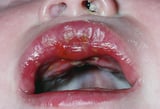 , toxoplasmosis Toxoplasmosis in Newborns Toxoplasmosis is infection with the parasite Toxoplasma gondii. Information technology usually does non cause bug in healthy adults, but it can crusade serious illness in newborns and in people with a... read more , rubella Rubella in Newborns Rubella is a typically mild childhood viral infection that may, notwithstanding, have devastating consequences for infants infected before birth. Rubella is caused past a virus. The fetus or newborn may... read more , or Zika virus Zika Virus Infection Zika virus infection is a mosquito-borne viral infection that typically causes no symptoms but can cause fever, rash, joint hurting, or infection of the membrane that covers the white of the eye... read more than
-
Toxins (such as lead and methylmercury)
Some causes that can occur during nascence include
-
Insufficient oxygen (hypoxia)
Some causes that can occur after birth include
-
Severe head injury
-
Undernutrition of the child
Some children with intellectual inability may have abnormalities credible at birth or presently thereafter. These abnormalities may be physical as well equally neurologic and may include unusual facial features, a caput that is also large or as well small, malformations of the hands or feet, and various other abnormalities. Sometimes children have an outwardly normal advent only have other signs of serious illness, such equally seizures, sluggishness, vomiting, abnormal urine odor, and failure to feed and abound ordinarily. During their kickoff year, many children with more severe ID have delayed development of motor skills, and are deadening to gyre, sit, and stand.
However, most children with ID practice not develop symptoms that are noticeable until the preschool period. Symptoms become apparent at a younger historic period in those more severely affected. Unremarkably, the first trouble parents notice is a delay in language evolution. Children with ID are slower to use words, put words together, and speak in complete sentences. Their social development is sometimes slow considering of cognitive impairment and language deficiencies. Children with ID may be slow to learn to dress and feed themselves. Some parents may not consider the possibility of cognitive impairment until the child is in schoolhouse or preschool and is unable to go on up with age-appropriate expectations.
Children with ID are somewhat more likely than other children to have behavioral problems, such as explosive outbursts, temper tantrums, and physically aggressive or cocky-injurious behavior. These behaviors are oft related to specific frustrating situations compounded by an impaired ability to communicate and control impulses. Older children may be gullible and easily taken reward of or led into minor misbehavior.
-
Prenatal screening
-
Developmental screening
-
Formal intellectual and skills testing
-
Imaging tests
-
Genetic and other laboratory tests
Screening before birth (prenatal screening) can be washed to make up one's mind whether the fetus has certain abnormalities, including sure genetic disorders, that may crusade intellectual disability.
When doctors doubtable intellectual disability, children are evaluated by teams of professionals, including early intervention or school staff, a primary care doc, a pediatric neurologist or developmental pediatrician, a psychologist, voice communication pathologist, occupational or physical therapist, special educator, social worker, or nurse. These professionals evaluate a kid suspected of having intellectual inability by testing intellectual performance and looking for a cause.
Even though the cause of the child's ID may exist irreversible, identifying a disorder that caused the disability may allow doctors to predict the child'south future course, prevent further loss of skills, plan whatsoever interventions that can increase the child'south level of functioning, and counsel parents on the risk of having another child with that disorder.
Certain tests, such as ultrasonography Ultrasonography Prenatal diagnostic testing involves testing the fetus before nativity (prenatally) to make up one's mind whether the fetus has certain abnormalities, including certain hereditary or spontaneous genetic... read more , amniocentesis Amniocentesis Prenatal diagnostic testing involves testing the fetus earlier birth (prenatally) to make up one's mind whether the fetus has certain abnormalities, including certain hereditary or spontaneous genetic... read more , chorionic villus sampling Chorionic Villus Sampling Prenatal diagnostic testing involves testing the fetus before birth (prenatally) to determine whether the fetus has certain abnormalities, including certain hereditary or spontaneous genetic... read more , and various claret tests such every bit quad screening Triple and quad screening Prenatal diagnostic testing involves testing the fetus earlier nativity (prenatally) to determine whether the fetus has certain abnormalities, including sure hereditary or spontaneous genetic... read more than , can be done during pregnancy to identify weather condition that often upshot in ID. Amniocentesis or chorionic villus sampling is often washed for pregnant women over 35 years of age because they have an increased risk of having a baby with Down syndrome Down Syndrome (Trisomy 21) Down syndrome is a chromosome disorder acquired by an extra chromosome 21 that results in intellectual disability and physical abnormalities. Down syndrome is caused by an extra chromosome 21... read more than  and for meaning women who have a family unit history of metabolic disorders. The quad screen is a test washed in most pregnant women. It is done to measure levels of iv substances in a woman'south blood. The results of this test help doctors evaluate whether the fetus has an increased hazard of having certain conditions, such as Down's syndrome, trisomy eighteen Trisomy 18 Trisomy xviii is a chromosomal disorder caused by an actress chromosome eighteen that results in intellectual inability and physical abnormalities. Trisomy 18 caused by an extra chromosome eighteen. Infants... read more
 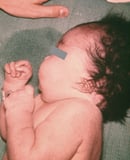 , or neural tube defects Neural Tube Defects and Spina Bifida Neural tube defects are a sure type of birth defect of the encephalon, spine, and/or spinal cord. Neural tube defects tin result in nerve damage, learning disabilities, paralysis, and expiry. The... read more .
Measuring the female parent'south blood level of blastoff-fetoprotein 2nd-Trimester Screening Prenatal diagnostic testing involves testing the fetus before birth (prenatally) to make up one's mind whether the fetus has certain abnormalities, including sure hereditary or spontaneous genetic... read more is a helpful screening test for neural tube defects Neural Tube Defects and Spina Bifida Neural tube defects are a certain type of nativity defect of the encephalon, spine, and/or spinal cord. Neural tube defects can consequence in nerve damage, learning disabilities, paralysis, and decease. The... read more than , Down syndrome Downwards Syndrome (Trisomy 21) Down syndrome is a chromosome disorder caused by an extra chromosome 21 that results in intellectual disability and concrete abnormalities. Down's syndrome is acquired by an extra chromosome 21... read more , and other abnormalities. Noninvasive prenatal screening (NIPS) detects modest amounts of DNA from the fetus in the mother'southward blood and uses that to diagnose genetic disorders in the fetus such as trisomy 21 (Down syndrome), trisomy thirteen Trisomy thirteen Trisomy 13 is a chromosomal disorder caused by an actress chromosome xiii that results in severe intellectual inability and physical abnormalities. Trisomy 13 is caused by an extra chromosome xiii... read more than 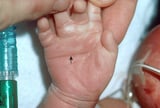 , or trisomy 18 Trisomy 18 Trisomy 18 is a chromosomal disorder acquired by an extra chromosome xviii that results in intellectual disability and physical abnormalities. Trisomy 18 caused by an actress chromosome xviii. Infants... read more and certain other chromosome disorders.
Because mild developmental problems are not e'er noticed by parents, doctors routinely exercise developmental screening tests during well-child visits. Doctors utilize uncomplicated questionnaires, such every bit the Ages and Stages Questionnaires or Child Development Inventories, to quickly evaluate the child's cognitive, exact, and motor skills. Parents can aid the doctor determine the child'due south level of functioning by completing a Parents' Evaluation of Developmental Condition (PEDS) test. Children who perform significantly beneath their age level on these screening tests are referred for formal testing.
Formal testing has three components:
-
Interviews with parents
-
Observations of the child
-
Tests in which the child'due south performance is compared with scores of many children of the same age
Some tests, such as the Stanford-Binet Intelligence Test and the Wechsler Intelligence Calibration for Children, are done to measure out intellectual ability. Other tests, such every bit the Vineland Adaptive Beliefs Scales, are done to assess areas such as functional communication, daily living skills, social abilities, and motor skills. Generally, these formal tests accurately compare a child's intellectual and social abilities with those of others in the aforementioned age group (called norm-referenced tests). However, children of different cultural backgrounds, not–English-speaking families, and very low socioeconomic status are more probable to practice poorly on these tests. For these reasons, a diagnosis of ID requires that the md integrate the test information with information obtained from parents and direct observations of the child. A diagnosis of ID is appropriate but when both intellectual and adaptive skills are significantly below average.
Newborns with physical abnormalities or other symptoms suggestive of a status associated with intellectual inability often need certain tests.
Other urine and claret tests are done depending on what doctors suspect is the cause.
A person with mild ID has a relatively normal life expectancy, and health care is improving long-term wellness outcomes for people with all types of intellectual disabilities. Many people with ID can back up themselves, tin live independently, and can be successfully employed with appropriate support.
Because intellectual inability sometimes coexists with serious physical problems, the life expectancy of people with ID may be shortened, depending on the specific condition. People with more than severe intellectual inability are more likely to require support for life. In general, the more severe the cognitive disability and the more physical issues the person has, the shorter the life expectancy.
-
Multidisciplinary back up
A kid with ID is best cared for by a multidisciplinary team consisting of the following:
-
Primary care doctor
-
Social workers
-
Spoken communication pathologists
-
Audiologists
-
Neurologists or developmental pediatricians
-
Psychologists
-
Nutritionists
-
Teachers
-
Orthopedists
Other professionals may also exist office of the team if necessary. Together with the family, these people develop a comprehensive, individualized program for the kid that is begun as before long as the diagnosis of ID is suspected. The parents and siblings of the child also need emotional back up and sometimes counseling. The whole family unit should be an integral role of the program.
The full array of a person's strengths and needs must exist considered in determining what kind of support is needed. Factors such as physical disabilities, personality problems, mental illness, and interpersonal skills are all taken into consideration. People with ID and coexisting mental health disorders such as depression may be given appropriate drugs in dosages similar to those given to those without ID. All the same, giving a child drugs without doing behavioral therapy and making environmental changes is ordinarily non helpful.
All children with ID do good from special didactics. The federal Individuals with Disabilities Education Human action (IDEA) requires public schools to provide complimentary and appropriate education to children and adolescents with ID or other developmental disorders. Teaching must be provided in the least restrictive, most inclusive setting possible—that is, a setting where the children take every opportunity to interact with nondisabled peers and take equal access to community resources. The Americans with Disability Human activity and Department 504 of the Rehabilitation Human action also provide for accommodations in schools and other public settings.
A child with intellectual disability commonly does best living at dwelling house. Nevertheless, some families cannot provide intendance at dwelling house, especially for children with severe, circuitous disabilities or behavior concerns. This determination is difficult and requires extensive discussion between the family and their entire back up team. The family may need psychologic support. A social worker tin can organize services to assist the family. Help can exist provided by twenty-four hour period care centers, housekeepers, child intendance givers, and respite care facilities. Most adults with ID alive in community-based residences that provide services appropriate to the person'due south needs, as well as piece of work and recreational opportunities.
The following are English-language resources that may exist useful. Please note that THE Manual is not responsible for the content of these resource.
-
Individuals with Disabilities Education Human action (IDEA): A United States law that makes bachelor free appropriate public education to eligible children with disabilities and ensures special education and related services to those children
-
March of Dimes: An organization aiming to better the health of mothers and babies through research, advocacy, and education
Source: https://www.msdmanuals.com/home/children-s-health-issues/learning-and-developmental-disorders/intellectual-disability
0 Response to "What Types of Intellectual Disability Are Described by the Term Cultural-familial?"
Post a Comment